 சினிமா
 டிவி
 Podcast
 iPaper
 கோயில்கள்
 புத்தகங்கள்
 Subscription
 திருக்குறள்
 கடல் தாமரை

BITS Pilani Skill Centre in Chennai for Engineering students!
BITS Pilani Skill Centre in Chennai for Engineering students!
நவ 04, 2026 02:48 AM
நவ 04, 2026 02:48 AM

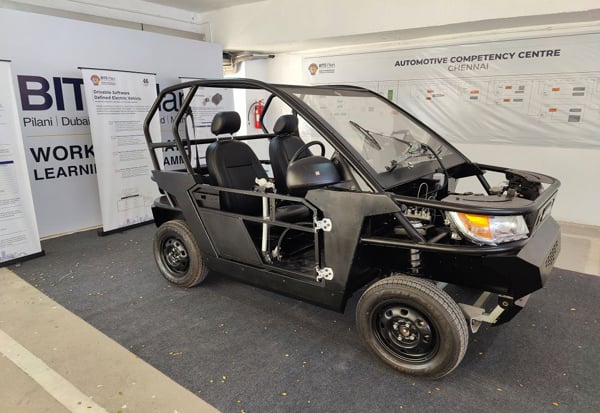
BITS Pilani operates a specialised skill development centre in Chennai to equip engineering students and working professionals with skills that meet emerging industry requirements.
The centre offers hands-on training in emerging technologies, including electric vehicle (EV) technology, software-defined vehicles and artificial intelligence (AI). It also undertakes research projects aimed at addressing real-world industrial challenges.
The primary objective is to bridge the gap between classroom learning and practical industry requirements. Final-year undergraduate students get opportunities to gain professional experience by working on projects in collaboration with industry partners. Postgraduate and research students are provided access to laboratory facilities, enabling them to align their research projects with specific industry requirements.
The centre also supports working professionals seeking to acquire new skills across different technology domains by providing access to technical resources and facilities that may not be available within their organisations. As students work on projects based on actual challenges faced by companies, both learners and organisations benefit from the collaboration.
Focus on Software-Defined Vehicles
When the centre was established, it identified two major areas of technical focus: software-defined vehicles and electric vehicle technology.
Modern vehicles use several Electronic Control Units (ECUs) to manage different functions. A single vehicle can contain as many as 150 such units. Software-defined vehicle technology aims to replace multiple independent control systems with a centralised computing architecture that manages various vehicle operations.
Similar to how new applications and software updates introduce additional features to smartphones, this technology enables vehicle manufacturers to add new functions and improve existing capabilities through software updates.
For this purpose, vehicle functions are organised into different zones connected to a central computer through what is known as 'Zonal Architecture'. With the growing demand for this technology in the global automotive industry, the centre continues to update its training programmes to keep pace with developments.
Comprehensive Training in Electric Vehicle Technology
The centre's second major focus area, the E-Mobility Centre, specialises in the technical aspects of electric and hybrid vehicles.
Students receive practical training in traction motor design, power electronics, overall vehicle architecture, electrical energy management and motor control.
The curriculum also covers internationally recognised engineering methodologies, including Model-Based Design, which uses mathematical models for system design, as well as Software-in-the-Loop (SIL) and Hardware-in-the-Loop (HIL) simulations.
These techniques help engineers test and validate technologies under simulated real-world conditions before integrating them into vehicles.
Students also work on emerging technologies such as steer-by-wire systems, Advanced Driver Assistance Systems (ADAS), driver drowsiness detection and AI-based object detection.
Opportunities for Autonomous Vehicles
Although the widespread deployment of fully autonomous vehicles on Indian public roads faces several challenges, particularly those related to infrastructure, the centre sees considerable potential for low-speed autonomous vehicles operating within specific environments.
Such vehicles could be used for nighttime surveillance in residential areas, transporting goods within warehouses and ferrying passengers to aircraft at airports. However, these applications would require the necessary government approvals.
The centre also points out that India is not yet fully equipped to support complex autonomous driving operations on public roads, particularly those involving high-speed traffic, interaction with other vehicles and overtaking manoeuvres.
Strengthening Industry Collaboration
BITS Pilani is collaborating with various organisations to develop research and training programmes that address specific industry requirements. Technical collaborations are underway with companies such as Bosch and Microchip, particularly in areas such as cybersecurity.
The institution has also signed memoranda of understanding (MoUs) with several foreign universities and academic institutions. However, its focus extends beyond signing agreements to implementing practical projects and developing meaningful research outcomes through these partnerships.
Industry collaboration is given high priority at the centre. Companies share their actual technical challenges with its faculty and researchers. Even when organisations cannot disclose complete details of a particular problem, students and researchers work on developing suitable models and technical solutions to address the challenges.
Weekend Training for Working Professionals
The centre offers short-term certification and skill-enhancement programmes for industry professionals.
Recognising that senior working professionals may find it difficult to commit to long-term training, the centre has introduced micro-credential programmes. These are designed to be completed over six to eight weekends, spread across approximately four months. Specialised one- or two-day training sessions in specific technical areas are also planned.
An important feature of these programmes is their emphasis on practical learning rather than theoretical instruction alone. Participants receive hands-on training using laboratory equipment. Classes are conducted in the morning, while afternoons are devoted to practical technical sessions in the laboratories.
Professionals can enrol through corporate-sponsored programmes, in which companies nominate their employees, or register individually.
Government Initiatives and Employability Skills
The centre also participates in skill development and employment-generation initiatives undertaken by various state governments, including Tamil Nadu.
A key objective of these initiatives is to identify talented young people not only in urban centres but also across different regions and equip them with technical skills that improve their employment prospects.
Efforts are also underway to provide faculty development and skill-enhancement programmes for engineering college professors in Tamil Nadu. The initiative aims to help faculty members update their teaching methods and course content in line with current industry requirements.
The centre is also exploring opportunities to participate in government-led projects, including research initiatives in the defence sector.
Updating Curricula to Match Technological Changes
Given the rapid pace of technological development, training programmes need to be updated periodically. The centre aims to revise its course content every three to five years, drawing on international curricula, feedback from industry partners and students' experiences.
Recent developments in areas such as artificial intelligence and autonomous vehicle technology are also being incorporated into the training programmes.
Looking ahead, the centre aims to expand its research activities through industry consultation and corporate funding. A proposal is also under consideration to integrate training offered in specialised laboratories directly into the curricula of selected engineering degree programmes.
Advice for Students: Never Stop Learning
Educators advise students to make continuous learning a habit, even after completing their degrees.
With technology evolving rapidly, the knowledge and skills required in the engineering profession have changed significantly over the decades. What an engineering graduate learned 30 years ago may no longer be sufficient to meet today's industry requirements.
Therefore, learning should not end with obtaining a degree. Students and professionals must stay informed about emerging technologies and continuously upgrade their skills.
The centre's core philosophy is that a degree is only the beginning of a learning journey. In a technology-driven world, those who continuously update their knowledge and adapt to changing industry requirements are better positioned to access future employment and career growth opportunities.
-- Paramesh Chidambaram, Associate Professor, BITS WILP

Advertisement