 சினிமா
 டிவி
 Podcast
 iPaper
 கோயில்கள்
 புத்தகங்கள்
 Subscription
 திருக்குறள்
 கடல் தாமரை

TVR: Education Alone Can End Caste and Religious Divides
TVR: Education Alone Can End Caste and Religious Divides
ஜூலை 22, 2026 07:13 PM
ஜூலை 22, 2026 07:13 PM

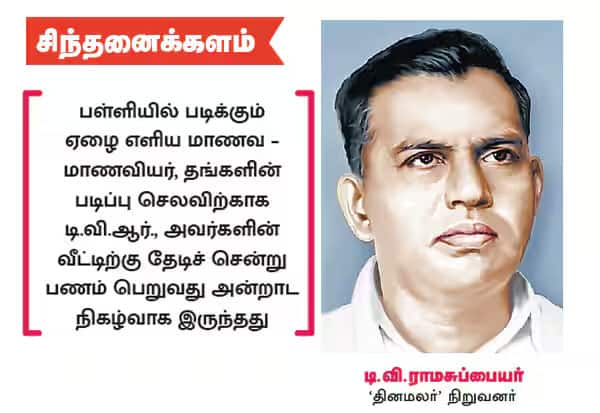
The true liberation of a society lies not merely in political freedom, but in the emancipation of its people's minds. A close look at the life of T.V. Ramasubbaiyer (TVR), founder of Dinamalar, reveals that from an early age he possessed a deep conviction that one must work for the welfare and enlightenment of society.
Viewing social progress as his singular mission, TVR recognized the transformative power of education and dedicated his life to making it accessible to all.
He believed that quality education was indispensable for people who had long lived under oppression to realize their dignity as free individuals and to use scientific and social advancements to build a better future.
More importantly, TVR firmly believed that education alone could free society from the narrow, regressive barriers of caste and religion that divided people.
At a time when education was largely the privilege of the affluent, he challenged this inequality by devoting himself to the cause of ensuring that education should be available to everyone—simple, accessible, and free.
A Lifetime of Educational Service
TVR's contributions to education deserve a permanent place in history. It was a common sight for economically disadvantaged schoolchildren to visit his home to seek financial assistance for their education.
What made this remarkable was the trust he inspired. Children would enter his home without their parents and confidently ask for help, treating him as one of their own. Such was the bond he had built with them.
He always lived by one guiding principle: "Never tell anyone that I helped you." Although he earned his wealth through immense hard work and sacrifice, he found joy in giving it away to those in need rather than publicizing his generosity.
Building the Foundation for Universal Education
The historic foundation for Kanyakumari district's high literacy rate was laid in 1946 through the Compulsory Education Scheme introduced by the then Diwan, Sir C.P. Ramaswami Aiyar.
The first school under this initiative was established in Vellamadam, a village in the Nanjil region. A committee was formed to implement the scheme successfully, and TVR was entrusted with a key leadership role.
Determined to turn the initiative into a people's movement, TVR travelled from village to village alongside the then Director of Public Instruction A.N. Thambi and prominent public figures T.M. Chidambaranatha Pillai, R.S. Nadar, and S. Draviya Nadar. They personally explained the importance and benefits of compulsory education to the public.
Their efforts won overwhelming public support. In addition to government funding, people generously contributed through community trusts and personal donations.
Within just three months, 50 school buildings had been established. Many poor families even donated their land free of cost for the construction of schools.
The primary schools founded in the Nanjil region during that period have since multiplied into thousands. TVR believed that widespread access to quality primary education would eventually eliminate caste and religious conflicts from the region. History proved his vision to be remarkably accurate.
Vision Beyond Primary Education
Having sparked a revolution in elementary education, TVR also aspired to expand opportunities for higher learning.
He envisioned the establishment of the first college in Nagercoil and later dreamed of creating a university dedicated to advancing education and research across Kanyakumari district.
To realize this vision, he collaborated with renowned Tamil scholar Prof. V.I. Subramaniam, then Head of the Tamil Department at the University of Travancore. Together they prepared a comprehensive proposal for establishing a university. That proposal later became an important reference document in the region's educational development.
A Legacy That Endures
TVR demonstrated through his life's work that education is the only enduring solution to preventing narrow identities based on caste and religion from dominating human minds. By promoting rational thinking, equal opportunity, and social awareness through education, he laid the foundation for lasting social reform.
His lifelong commitment to educational advancement remains an enduring legacy and a source of inspiration for future generations.
Source: Kadal Thamarai, a biographical work on the life of T.V. Ramasubbaiyer.
— L. Murugaraj, Writer

Advertisement